Restricted Use Pesticide Usage: Upcountry Maui
Makawao, pukaLani, and Kula
Executive Summary (2020 - 2021)
This brief examines reported Restricted Use Pesticide (RUP) applications in Upcounty Maui including Makawao, Pukalani & Kula for 2020–2021. Data show extensive use of highly hazardous chemicals, including fumigants, organophosphates, carbamates, synthetic pyrethroids, and persistent herbicides. These chemicals pose serious risks to human health, particularly children, and to the environment.
It is important to note the GIS mapping for 2020 and 2021 below is likely inaccurate and underestimated. Incomplete/poor pesticide use data reporting for 2020 and 2021, including the application of fumigants (Telone) that likely occurred in Makawao in 2021 could not be mapped.
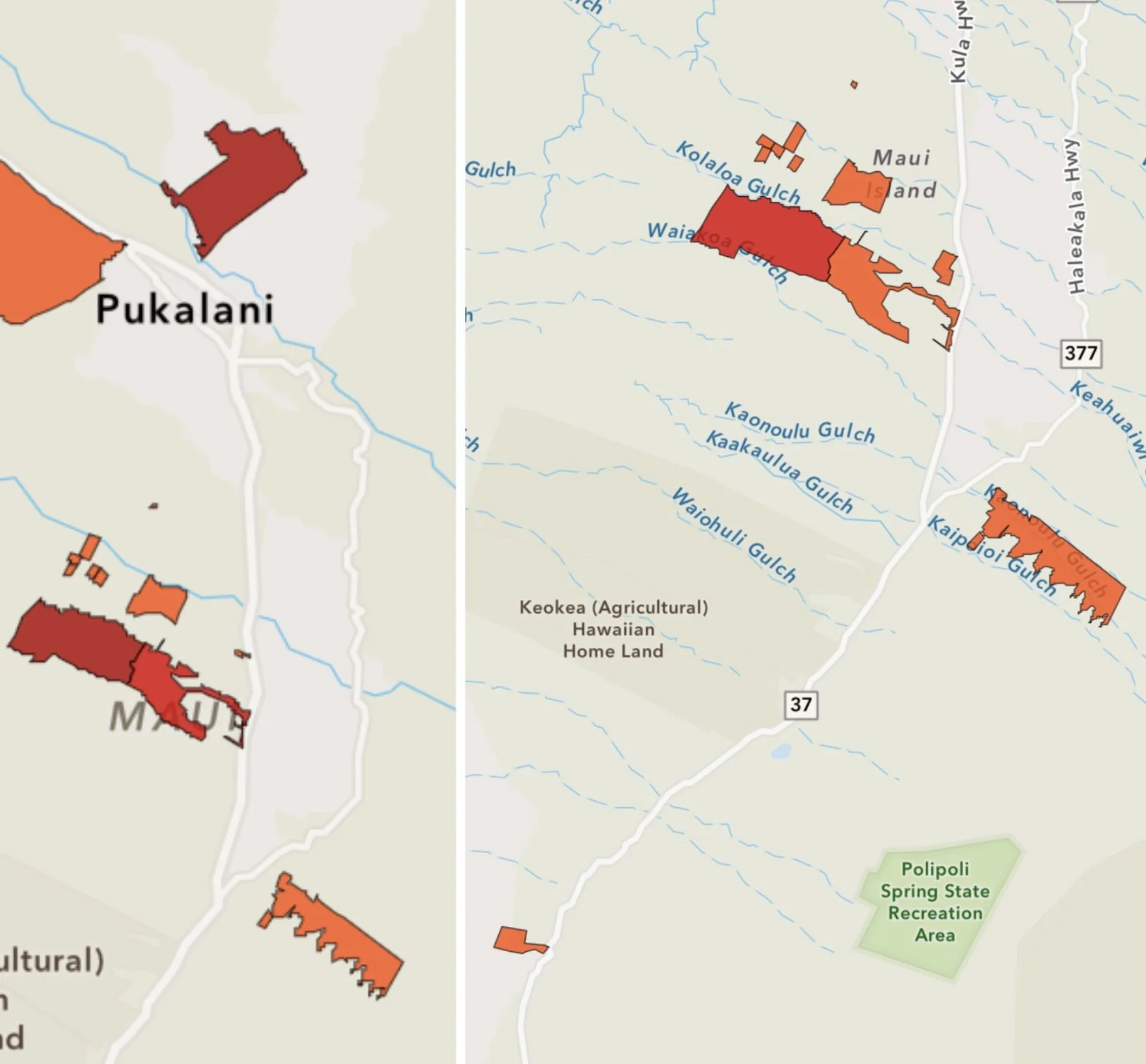
2020 & 2021
Key Findings
Fumigants dominate use, with Telone II (1,3-Dichloropropene) and Dormex applied in large quantities, posing drift, inhalation, and groundwater contamination risks.
Neurotoxic insecticides (diazinon, methomyl, oxamyl, naled) were applied repeatedly.
Synthetic pyrethroids and persistent herbicides threaten pollinators, aquatic life, and water quality.
Chemical mixtures are standard, creating compounded health and ecological risks not fully assessed under current regulations.
Inaccuracies in the data reporting prevented 117lbs of active ingredient, across five Maui parcels, from being able to be mapped. Based on known use patterns, one parcel is likely Haliʻimaile Pineapple Company, the island’s only known prior Telone user.
2020 Findings
Telone II (1,3-Dichloropropene) — 20,354 lbs AI; volatile, probable human carcinogen
Dormex (Hydrogen Cyanamide) — 143 lbs AI; highly reactive, drift and respiratory hazard
Methomyl — 173.7 lbs AI; acute neurotoxin
Diazinon — 350 lbs AI; developmental neurotoxicity risk
Paraquat — 31.4 lbs AI; extreme acute toxicity, no antidote
Pyrethroids — Permethrin, Lambda- and Zeta-cypermethrin, Esfenvalerate, Bifenthrin; high aquatic toxicity
S-metolachlor & Tolfenpyrad — persistent herbicides with groundwater mobility
Observation: Multiple RUPs applied in the same areas, elevating cumulative exposure risk near schools and homes.
2021 Findings
Telone II (1,3-D) — 18,657 lbs AI; consistent high exposure risk
Dormex — 379.5 lbs AI; significant increase
Methomyl & Oxamyl — 166.6 lbs AI / 15.84 lbs AI
Cyantraniliprole / Chlorantraniliprole — 12.12 / 4.89 lbs AI
Pyrethroids — multiple compounds, including Permethrin, Lambda- and Zeta-cypermethrin, Bifenthrin, Esfenvalerate
Paraquat — 34.2 lbs AI
S-metolachlor — 13.97 lbs AI
Naled — 113.2 lbs AI
Observation: Toxic chemical load increased slightly from 2020; cumulative risk remains high, with repeated overlapping applications.
Human Health Concerns
Children at greatest risk, especially in schools near pesticide applications (Makawao Elementary, Kula Elementary, King Kekaulike High, Pukalani Elementary)
Neurodevelopmental harm – organophosphates, carbamates
Acute poisoning – cholinesterase inhibition from carbamates and organophosphates; respiratory distress
Endocrine and immune disruption – pyrethroids and chlorinated compounds
Chronic disease risk – Parkinson’s, cancer, reproductive harm
Exposure pathways: inhalation, dust/soil contact, contaminated water, drift
Environmental Concerns
Aquatic toxicity – pyrethroids, abamectin, emamectin, naled, bifenthrin
Pollinator decline – chlorantraniliprole, cyantraniliprole, pyrethroids
Groundwater contamination – S-metolachlor, Telone II, methomyl
Soil and ecosystem disruption – microbial community loss, reduced habitat quality
Cumulative ecological stress – repeated overlapping pesticide applications amplify long-term environmental harm
Why Mixture Effects Matter
Overlapping applications of fumigants, insecticides, herbicides, and pyrethroids increase human and ecological risks.
Combined exposures can cause: neurodevelopmental harm, endocrine disruption, chronic disease, immune impacts, and long-term ecological damage.
Regulatory frameworks rarely assess cumulative or synergistic exposure, leaving children and communities particularly vulnerable.
Schools at Risk
There are nine schools in this region within one mile of RUP applications (2020-2021).
Haleakala Waldorf School, Kula
Horizons Academy of Maui, Inc., Kihei
Montessori School of Maui, Makawao
Kalama Intermediate, Makawao
Kula Elementary, Kula
Makawao Elementary, Makawao
Pukalani Elementary, Pukalani
Waihee Elementary, Waihee
Wailuku Elementary, Wailuku
Overall Conclusion
Pesticide use in Makawao, Kula & Upcountry is intensive, repetitive, and highly toxic, with significant implications for child health, community well-being, water quality, and ecosystem integrity. Findings underscore the need for:
Buffer zones around schools, homes, and water catchments
Stronger reporting and transparency of pesticide use
Cumulative and mixture-based risk assessment
Enhanced regulatory oversight and enforcement
Protective policies are urgently needed to reduce exposure to hazardous pesticides in frontline communities.
If you want the full Upcountry Maui Report, email safefarmssafefood@gmail.com 