Restricted Use Pesticide Usage: Central and South Maui
Maʻalaea-Wailea
Executive Summary (2020–2021)
This brief summarizes the reported restricted use pesticide (RUP) usage in Central and South Maui, including Maʻalaea, Kīhei, Wailea, and Kānahena, for 2020–2021. Data indicates repeated application of highly hazardous pesticides—acutely neurotoxic insecticides, toxic herbicides, and persistent systemic insecticides—posing elevated risks to children, workers, residents, and coastal ecosystems. Gaps in reporting suggest actual exposure may be higher than reported and unable to be mapped for the area. Therefore the mapped usage below is likely underestimated.
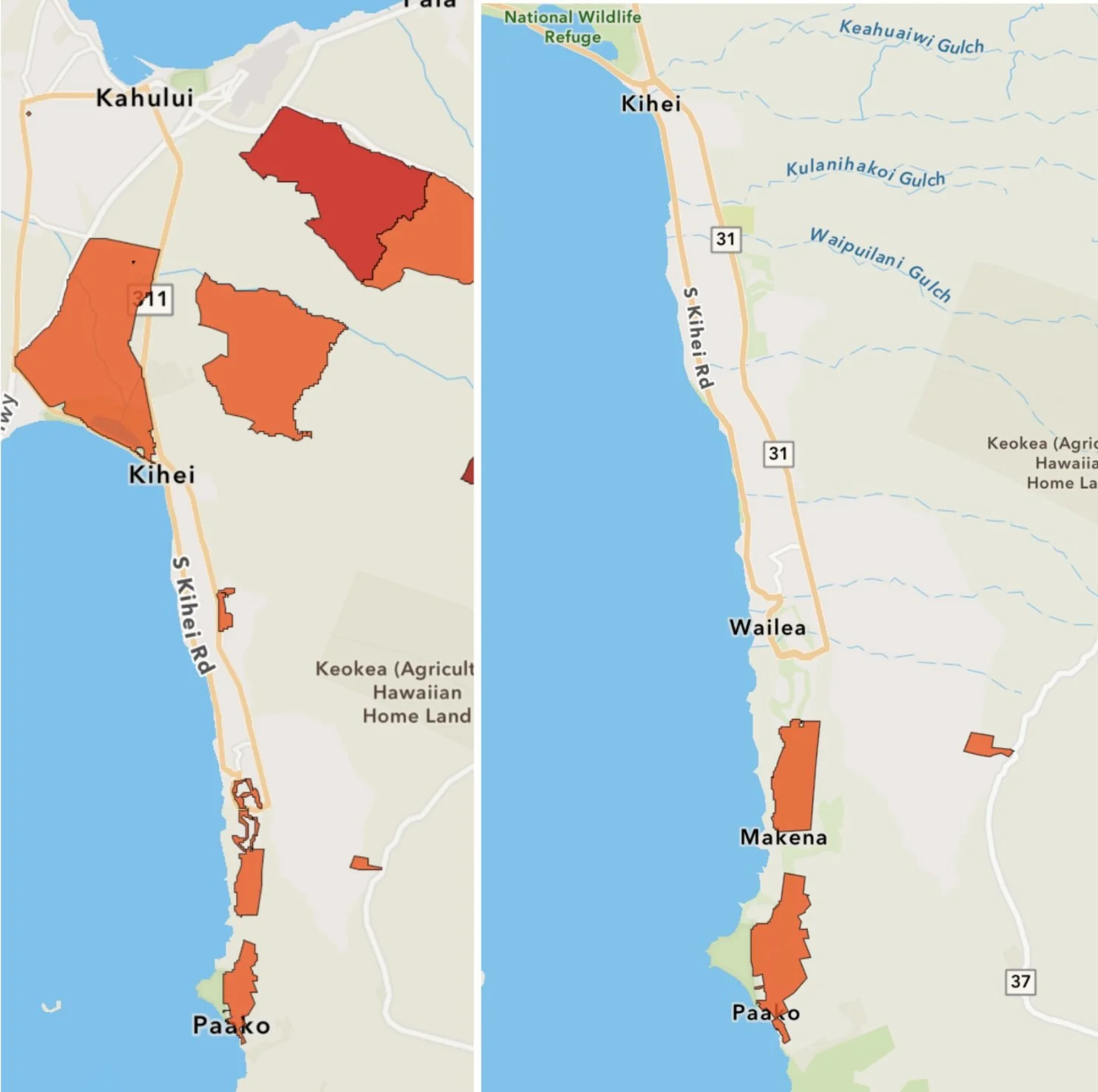
2020 & 2021
Key Findings
Acute Neurotoxic Insecticides: Pyrethroids (bifenthrin, beta-cyfluthrin, lambda-cyhalothrin, zeta-cypermethrin) and avermectins (abamectin) were widely applied, causing neurotoxic and aquatic toxicity risks.
Highly Toxic Herbicides: Paraquat dichloride (~720 lbs AI in Central Maui 2020) is among the most acutely toxic herbicides globally.
Persistent Systemic Insecticides: Chlorantraniliprole (Acelepryn/Coragen) contributes to cumulative ecological loading due to persistence and mobility.
Groundwater-Mobile Herbicides: S-metolachlor (~174 lbs AI 2020) presents long-term contamination concerns.
Chemical Mixtures: Communities face overlapping exposures, amplifying risks to neurological development, endocrine and immune systems, and ecological health.
Inaccuracies in the data reporting prevented 117lbs of active ingredient, across five Maui parcels, it is likely that some of these parcels are located in Central Maui, where applications also occurred in 2020.
2020–2021 Use Highlights
Central Maui & Kīhei (2020)
Paraquat: 720.9 lbs AI
S-metolachlor: 174.5 lbs AI
Bifenthrin: 7.84 lbs AI
Other pyrethroids and avermectins: ~14 lbs AI combined
Chlorantraniliprole: 11.86 lbs AI
Wailea–Kānahena
2020: Bifenthrin 16.03 lbs AI; Chlorpyrifos 102 lbs AI
2021: Bifenthrin 4.86 lbs AI (Talstar Select & GC), Chlorantraniliprole 14.38 lbs AI
Year-to-Year Trends
2021 reporting shows no mappable use in Central Maui/Kīhei, but regional exposure persists due to proximity, watershed connectivity, and drift.
Use in South Maui continues to have potential for high ecological and public health risk.
Reliance on highly hazardous pesticides remains consistent, with cumulative and synergistic exposure effects not adequately evaluated by current regulations.
Schools at Risk (2020-2021)
There are nine schools in this region located within one mile of RUP applications (2020-2021):
Horizons Academy of Maui, Inc., Kihei
Baldwin High, Wailuku
Iao Intermediate, Wailuku
Kihei Elementary, Kihei
Lokelani Intermediate, Kihei
Puu Kukui Elementary, Wailuku
Waihee Elementary, Waihee
Wailuku Elementary, Wailuku
Kulanihakoʻi High, Kihei
Policy Implications
Children and communities in Central and South Maui are at risk from drift, inhalation, groundwater contamination, and aquatic toxicity.
Existing regulatory frameworks do not account for mixture or cumulative exposures near homes, schools, and recreational areas.
Policies should address transparent reporting, exposure reduction, and cumulative risk assessment, with special consideration for sensitive populations and coastal ecosystems.
Recommendation: Strengthen protections, enhance monitoring and reporting, and adopt policies evaluating pesticide risk holistically, not one chemical at a time.
If you want the full Central & South Maui Report, email safefarmssafefood@gmail.com 